


Influence Diplomacy at the Heart of Contemporary Geopolitical Realignments
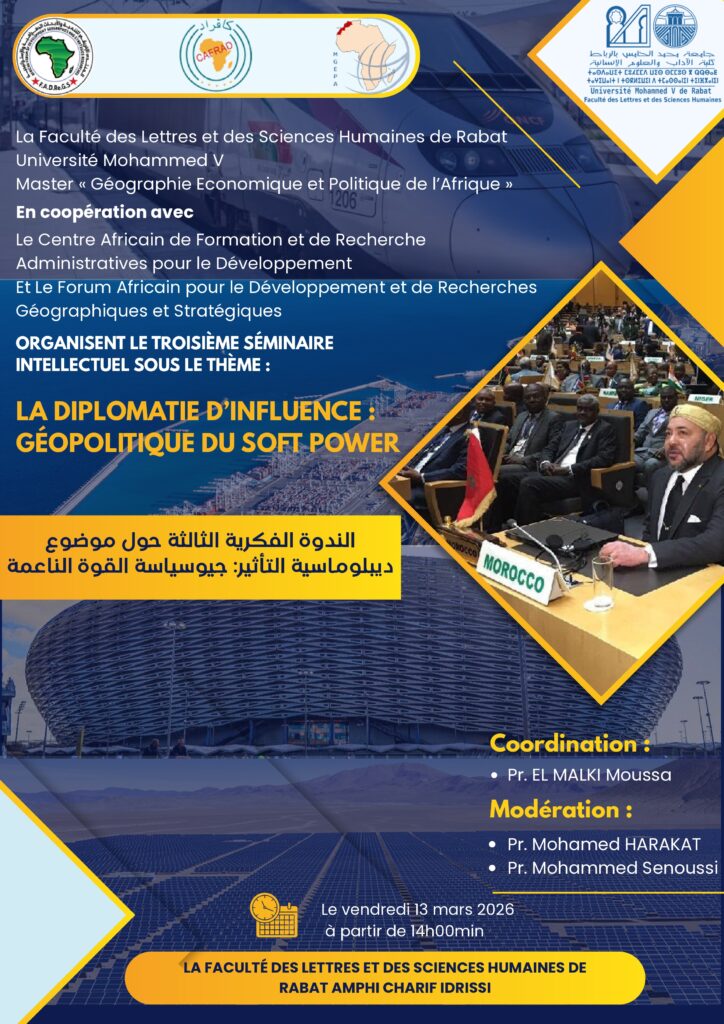
On Friday, March 13, 2026, the Faculty of Arts and Humanities in Rabat, part of Mohammed V University, will host the third intellectual seminar on the theme: “Influence Diplomacy: Geopolitics of Soft Power.”
Organized within the framework of the Master’s program in “Economic and Political Geography of Africa,” in cooperation with the African Training and Research Centre in Administration for Development (CAFRAD) and the African Forum for Development and Geographic and Strategic Research, this seminar will bring together academics, researchers, diplomats, experts, and students to discuss the new dynamics of power in the international system.
A Strategic Reflection on the Transformation of Power
In an international context marked by the reshaping of geopolitical balances, the intensification of rival narratives, and the rise of non-state actors, influence diplomacy has emerged as a central lever in contemporary international relations.
The proceedings will highlight the shift from a primarily interstate diplomacy based on hard power to a broader, multidimensional, and strategic diplomacy, integrating global communication, economic, cultural, academic, and digital diplomacy. Soft power is now emerging as a crucial instrument for strategic projection and the sustainable structuring of geopolitical environments.
High-Level Presentations
The opening session will feature official addresses by Professor Zakaria Boudhim, Dean of the Faculty; Dr. Coffi Dieudonné Assouvi, Director General of CAFRAD; and Professors Mohamed Harakat and Mohammed Senoussi, leading academic figures in the fields of strategic studies and international affairs.
The academic presentations will address several key themes:
Africa’s cognitive sovereignty in the face of battles over perceptions and narratives;
The transformation of the diplomatic profession in the era of soft power;
The demonopolization of strategic influence in a multipolar world;
The construction of an independent African school of geopolitics;
Africa’s role as a laboratory for new forms of influence diplomacy;
The geopolitics of critical raw materials as an instrument of sovereignty;
The importance of information technologies and scientific production in the hierarchy of power.
Africa at the heart of the reshaping of global power
One of the seminar’s major contributions lies in putting Africa’s positioning into perspective within the new configurations of global influence. Far from being a passive periphery, the continent appears as a strategic space where hybrid instruments combining infrastructure, standards, finance, security, and information systems are being deployed.
The speakers will address the need for Africa to strengthen its cognitive sovereignty, consolidate its scientific production capacities, and structure a coordinated narrative diplomacy on a continental scale.
Morocco and Influence Diplomacy
The discussions will also highlight Morocco’s experience in soft power, based on economic, cultural, and religious diplomacy, as well as a network of strategic alliances in Africa and beyond. In a changing international environment, influence diplomacy is emerging as a defining characteristic of 21st-century geopolitics.
A Structuring Academic Dynamic
This seminar is part of the academic dynamic of the Master’s program in “Economic and Political Geography of Africa,” which aims to train a new generation of analysts capable of deciphering the continent’s geostrategic challenges in a changing world.
Through this academic conference, the organizers will create a space for strategic reflection, contributing to strengthening dialogue between universities, institutions, and public decision-makers, while consolidating Morocco’s role as an academic and diplomatic platform in Africa.