


SUMMARY NOTE: Third Intellectual Seminar
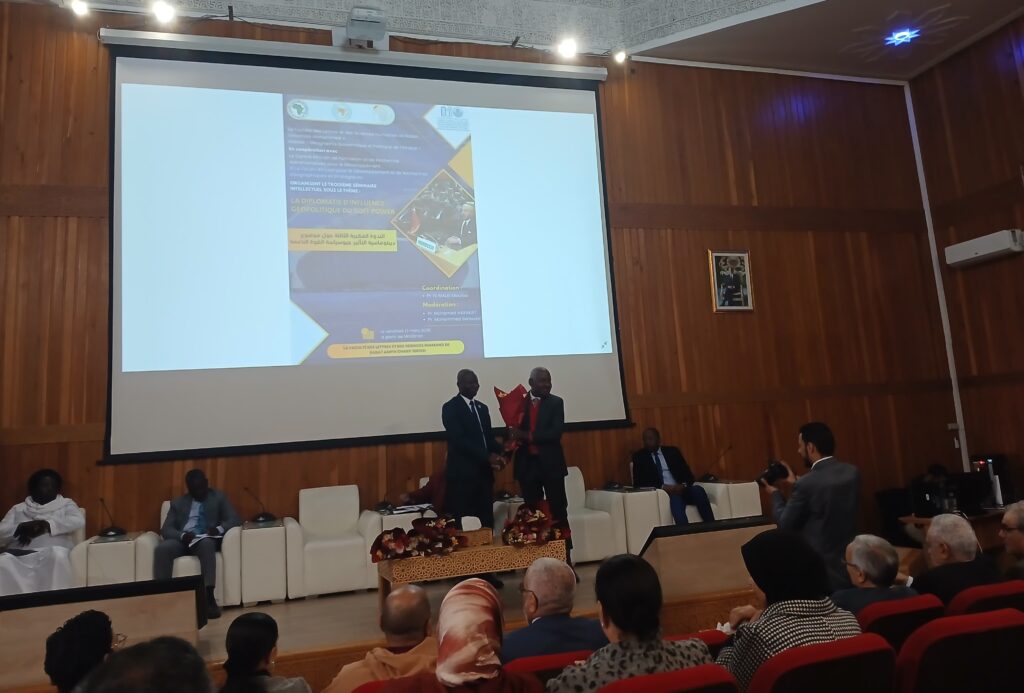
Theme: Influence Diplomacy: Geopolitics of Soft Power
Date: March 13, 2026
Location: Faculty of Arts and Humanities of Rabat
Organizers:
- CAFRAD
- Faculty of Arts and Humanities of Rabat
- Master’s Program in Economic and Political Geography of Africa
- African Training Forum for Development and Geographic and Strategic Research
- Context
The contemporary international system is undergoing a profound transformation marked by an evolution in approaches to international, diplomatic, and partnership relations. Traditional logics of domination by force are tending to fade in favor of new dynamics based on influence, knowledge, and the development of talent. In this new configuration, influence diplomacy is emerging as a major strategic lever, redefining the modalities of interaction between states and international actors. Soft power is thus becoming a central instrument for projection, cooperation, and geopolitical repositioning. It is from this perspective that CAFRAD, as a leading pan-African actor and hub of soft power, is committed to promoting a new stance for the African continent in interstate relations and public-private partnerships. In collaboration with its academic and scientific partners, CAFRAD co-organized, on March 13, 2026, an intellectual seminar dedicated to influence diplomacy. This seminar aimed to explore the theoretical and geopolitical foundations of soft power, analyze contemporary influence strategies, examine Africa’s place in the reshaping of the international order, and highlight African and Moroccan experiences in academic, cultural, and economic diplomacy.
- Diplomatic Scope
This seminar took on significant diplomatic importance by engaging representatives of CAFRAD member states accredited to Morocco. This participation illustrates the growing interest of African states in the challenges of influence diplomacy within a changing international context. Several representatives of CAFRAD member states took part in this meeting and expressed their gratitude to the entire organizing team of this seminar.
The Ambassador of the Republic of Angola and his delegation;
Representatives from the Embassies of Liberia, Gabon, Burkina Faso, Mali, and Côte d’Ivoire.
In his address, the Ambassador of the Republic of Angola commended CAFRAD’s unifying role in promoting the transformation of the African continent. He emphasized the relevance of the theme, highlighting the need to prioritize instruments of influence and cooperation to address contemporary challenges, particularly international conflicts. He also highlighted Morocco’s vision of soft power, championed by His Majesty King Mohammed VI, as a model for South-South cooperation and strategic partnership, particularly in strengthening Morocco-Angola relations. The other diplomatic representatives, in turn, reaffirmed their commitment to supporting CAFRAD’s initiatives aimed at promoting renewed African governance based on influence, cooperation, and strategic innovation.
III. Thematic Presentations
The seminar was structured around several academic and strategic presentations:
- Coffi Dieudonné Assouvi, Director General of CAFRAD, opened the proceedings with a presentation on influence diplomacy: lessons from the transformation of a profession. He emphasized key concepts such as influence leadership, strategic negotiation, lobbying, and the connections between hard power, soft power, and smart power.
- Boussif Mostafa addressed the issue of Africa’s cognitive sovereignty, highlighting the continent’s vulnerabilities to external influences and proposing a framework based on control over narratives, data, and scientific production.
- Fouad Akki offered a comparative analysis of influence diplomacy, emphasizing its gradual erosion of power by the emergence of new powers on the international stage.
- Professor Mohammed Senoussi presented Africa as a laboratory of power, analyzing the transformations of global power through the concepts of soft power, structural power, and complex interdependence.
- Moussa El Malki advocated for the creation of an independent African school of geopolitics, aiming to strengthen the continent’s intellectual autonomy in the production of strategic knowledge.
- Professor Mohamed El Kihel analyzed Moroccan soft power, highlighting its theoretical foundations and applications in international relations, while emphasizing its potential for the African continent.
- Mohamed El Hassouni examined the role of geologistics and critical raw materials as new instruments of influence and strategic sovereignty.
- Mazroub Anouar addressed scientific diplomacy, emphasizing the role of information technologies and knowledge production in the hierarchy of global powers.
- Conclusion
This seminar serves as a strategic forum for reflection, training, and the exchange of ideas on contemporary issues in influence diplomacy. It highlighted the need for Africa to adopt a proactive stance based on mastering the instruments of soft power. Discussions emphasized the need to strengthen African capacities for strategic influence, structure an independent African geopolitical thinking, promote academic, scientific, and cultural diplomacy as levers for transformation, and develop analytical frameworks and training programs adapted to global challenges. At the end of the seminar, participants expressed their desire to consolidate this forum for reflection and contribute to the emergence of a new generation of African decision-makers and researchers capable of leading a strategic vision for the continent within the international system.