Under the macro-leadership of Dr. Coffi Dieudonné ASSOUVI, CAFRAD is driving Africa’s digital, energy, ecological, and smart transformation, under the High Patronage of His Majesty King Mohammed VI, may God Almighty assist him.
In addition to his exceptional achievements in modernizing, improving governance, and transforming CAFRAD’s institutional framework, Dr. Coffi Dieudonné Assouvi has repositioned the pan-African intergovernmental organization as a leading center of excellence for profound, comprehensive, structural, and systemic transformation. This involves unlocking Africa’s full potential and building the Africa we envision, in line with the African Union’s Agenda 2063, through the training of leaders in action, the development of human capital and talent, the enhancement of human resources, the creation of partnerships and networks, research, innovation, knowledge management, benchmarking, and the sharing of experiences and best practices.
A vision supported by concrete actions and shared values
Thus, the Director General of CAFRAD has a clear, creative, and transformative vision for Africa.
CAFRAD’s strategic vision stems from the imperative to build and/or reinvent a (modern) public administration that is professional, accountable, e-commerce, smart, learning, teal, innovative, developmental, resilient, and robust. This will be achieved through talent development, institutional capacity building, and the sharing of actionable experiences, knowledge, and best administrative practices—the foundation and driving force behind regional integration and sustainable and inclusive development. It is stated as follows:
To be a unique center of excellence effectively addressing the multiple challenges of comprehensive, systemic, digital, smart, societal, and sustainable transformations of public administrations in stable, modern, developmental, capable, and credible African states.
This vision is based on the values of: Authenticity, Humanism, Commitment, Integrity, and Openness to the World. Ethics, humanity, equity, sustainability, and inclusion are at the heart of public action in CAFRAD member states:
- Commitment through leadership, accountability, and participation;
- Respect for individuals and institutions;
- Openness to the world, cultures, and ways of thinking;
- Exemplary conduct and actions for the public good.
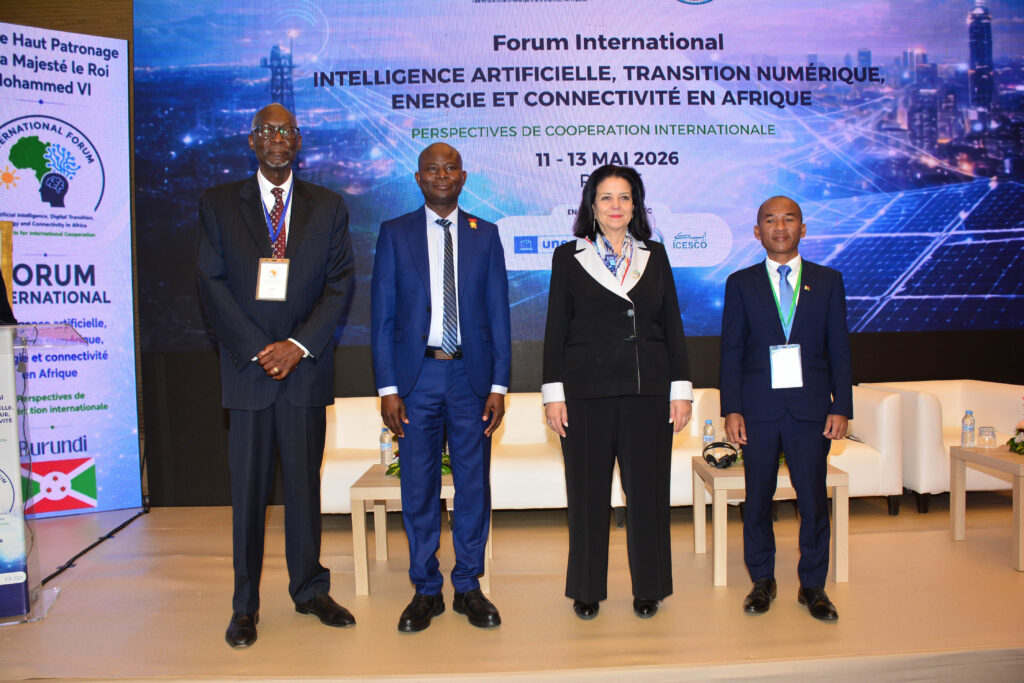
Within the framework of this vision, the first edition of the High-Level International Forum on the Digital, Energy, Ecological, and Smart Transformation of Africa was held, entitled:
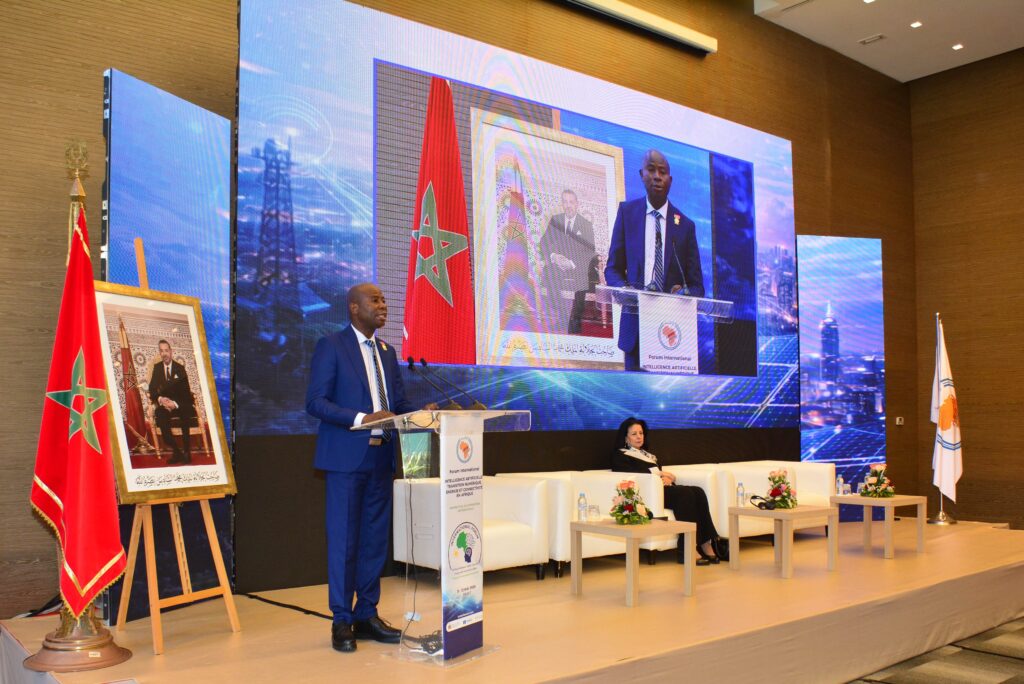
Artificial Intelligence, Digital Transition, Energy, and Connectivity in Africa: Prospects for International Cooperation, under the High Patronage of His Majesty King Mohammed VI, may God assist and glorify him, from May 11 to 13, 2026, at CAFRAD headquarters in Rabat, Morocco.
The Forum’s Purpose: A Holistic Approach to AI and the Energy Transition
The High-Level International Forum on Africa’s Digital, Energy, Green, and Smart Transformation, entitled “Artificial Intelligence, Digital Transition, Energy, and Connectivity in Africa: Prospects for International Cooperation,” held under the High Patronage of His Majesty King Mohammed VI, may God assist and glorify him, from May 11 to 13, 2026, at the CAFRAD headquarters in Rabat, was an unprecedented success.
This Forum, now officially named the High-Level International Forum on Africa’s Digital, Energy, Green, and Smart Transformation, is now institutionalized as one of CAFRAD’s flagship annual activities.
Faced with fierce global competition in advanced and emerging technologies and the need for regulation of artificial intelligence (AI), the Kingdom of Morocco has chosen a third path: responsible, ethical, human-centered digital technology and AI that integrates a just energy and ecological transition.
This path is also that of the African Union in its continental AI strategy, adopted by the AU Executive Council at its 45th Ordinary Session held on July 18 and 19, 2024, in Accra, Republic of Ghana. The vision of this strategy is: “A prosperous and integrated Africa where responsible, ethical, and Africa-centric AI is the driving force behind inclusive growth, resilience, socio-economic development, the empowerment of people, and the positioning of the continent as a key player in the global AI landscape.”
Indeed, as a digital leader and regional technology hub, the Kingdom of Morocco, through its Ministry of Digital Transition and Administrative Reform, supports and promotes all initiatives aimed at developing Afro-African and human-centered technologies.
This is why this high-level international forum on “Artificial Intelligence, Digital Transition, Energy and Connectivity in Africa: Prospects for International Cooperation” is under the High Patronage of His Majesty King Mohammed VI, may God assist him and grant him victory.
The Forum aims to establish a holistic approach to digital governance, sustainable development, and international cooperation. Sustainable and responsible technologies require clean or renewable energy to build a low-carbon, resilient, and intelligent society and economy. Therefore, there is a very close correlation between AI and energy. The development of AI requires critical minerals and the availability of electricity and water to power reactors, servers, and data centers. This is what gives our Forum its full meaning.
Indeed, the virtual nature of AI too often obscures the fact that its production or manufacturing depends on natural resources that are not inexhaustible. AI development relies on the construction of terminals, networks, and data centers, which requires the mining of rare minerals such as coltan, lithium, and cobalt. As the Economic, Social and Environmental Council (CESE) points out, “by 2050, the quantity of metals required could represent 3 to 10 times current production volumes: that’s more metal over the next 35 years than the cumulative amount produced since Antiquity.” Added to this is the increased energy consumption imposed by AI production: a question asked on ChatGPT consumes ten times more energy than a query sent to Google. In this context, the limited electricity production capacity of some countries forces them to return to coal-fired power plants. AI training also requires very large quantities of water, particularly for cooling servers. Referring to a Cornell University study from October 2023, the EESC explains that AI could consume between 4.2 and 6.6 billion cubic meters of water in 2027, which corresponds to a consumption slightly higher than that of Denmark.
The use of AI also depends on human resources. While the advent of AI may raise concerns about job losses, it should not obscure the importance of mastering the AI systems (AIS) used, especially since the requirement for human oversight is now enshrined in law. However, the capacity to manage AI projects is often lacking. This is evident in small organizations, but also in public authorities, which do not necessarily have the in-house expertise to carry them out successfully, or even simply to understand the state of the technologies and identify the solutions that the market can offer.
The high-level international forum concluded with the commitments of the revamped CAFRAD for the profound digital, energy, ecological, and smart transformation of Africa.
Rabat Commitments for a Digital and Energy Sustainable Africa