


Dr. Coffi Dieudonné ASSOUVI, honored by His Majesty King Mohammed VI, may Almighty God assist him and grant him victory, as a key player in Africa’s transformational change.
The exceptional efforts undertaken by Dr. Coffi Dieudonné Assouvi, Director General of CAFRAD, since assuming his duties in July 2024, to rehabilitate and modernize the Pan-African Intergovernmental Organization, improve its governance, and strengthen its status as a leading international organization with a regional focus in Africa, have been recognized by the highest authorities of most member states, including His Majesty King Mohammed VI, may Almighty God glorify him. His Majesty thus awarded his Royal Distinction to the Director General of CAFRAD for the depth of his intellectual contributions to Africa’s transformation and the promotion of South-South cooperation.
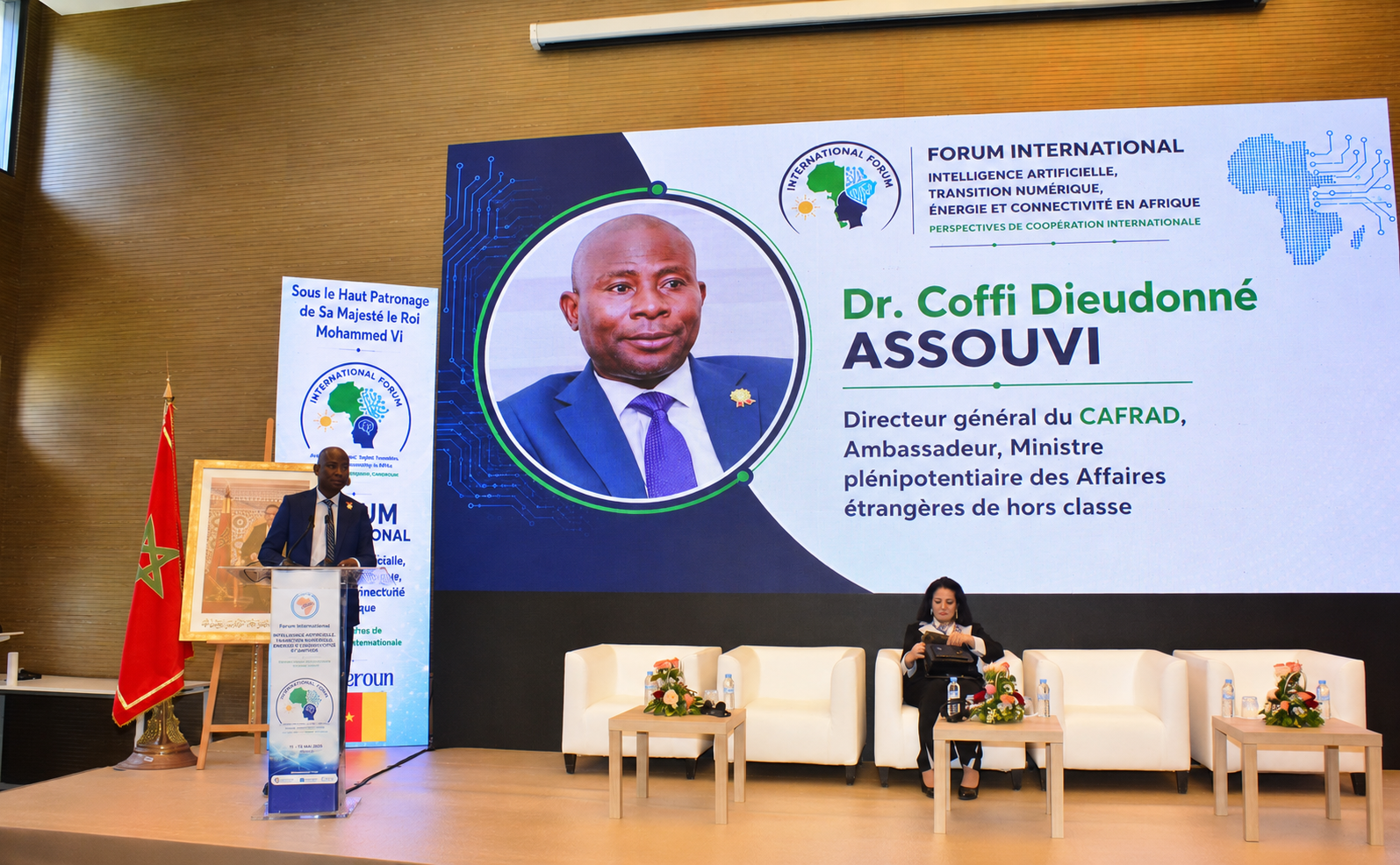
In February 2026, His Majesty King Mohammed VI, may God assist and glorify him, graciously bestowed his High Royal Patronage upon the High-Level International Forum on the Digital, Energy, Ecological, and Smart Transformation of Africa, entitled:
Artificial Intelligence, Digital Transition, Energy, and Connectivity in Africa: Prospects for International Cooperation
The High Royal Patronage was followed by congratulations extended to the Director General of CAFRAD, Dr. Coffi Dieudonné Assouvi, for this Royal Distinction. This is the very first time that an independent activity of CAFRAD has benefited from the High Royal Patronage since the Organization’s creation in 1962, and it is highly significant to acknowledge the transformational leadership of this Pan-Africanist who has dedicated his life to the profound and structural transformation of Africa. This high Royal Distinction is not only the culmination of efforts and sacrifices made, but also an exhortation to continue meeting the challenges of building a new Africa, “the Africa we want,” Agenda 2026 of the African Union (AU).
Context of the Director General’s Role, an Elected International Civil Servant
CAFRAD operates in a volatile, uncertain, intellectual, complex, international, intercultural, institutional, social, and demanding environment characterized by increased requirements for transformation, governance, performance, and regional and international influence. These developments have led to a progressive expansion of the Organization’s missions, as well as a more complex role for its Member States, technical and financial partners, universities, and other stakeholders.
The appointment of the new Director-General, Dr. Coffi Dieudonné Assouvi, in July 2024, takes place within this context, with a clear mandate for institutional recovery, structural reforms, modernization, and strategic repositioning of CAFRAD. This mandate, granted by the Council of Ministers, entails a high level of responsibility, encompassing managerial, ethical, organizational, technological, institutional, political, and diplomatic aspects.
A sincere commitment to serving African causes
Elected as Director-General by the 59th session of the CAFRAD Governing Body, held on July 9, 2024, Dr. Coffi Dieudonné Assouvi, a transformational, adaptive, authentic, and strategic leader, has launched a comprehensive reform and modernization project for the Organization, aiming to equip it with the necessary technical, legal, institutional, organizational, managerial, human, financial, and technological resources. The goal was to transform CAFRAD, the leading African organization, into a management tool for the sustainable development of the African continent, aligned with the African Union’s Agenda 2026, the United Nations’ 2030 Agenda for Sustainable Development, and national development programs. He successfully repositioned CAFRAD to make it more attractive, more efficient, and more effective in addressing Africa’s major development challenges, preparing the continent for the public policy challenges of tomorrow, and forging its own technological path.
CAFRAD prepares, trains, educates, and supports leaders and senior managers in the highest levels of responsibility in the exercise of their professions.
To this end, Dr. Coffi Dieudonné Assouvi is committed to developing a new type of African dedicated to good governance and the comprehensive and systemic transformation of Africa. The aim is to bring forth the new generation of leaders and managers who are uninhibited, ethical, authentic, lucid, transformative, bold, visionary, and who understand the global challenges of the world and the renaissance of Africa.
With CAFRAD, ethics, humanity, equity, sustainability, and inclusion are at the heart of tomorrow’s public action in CAFRAD member states.
At CAFRAD, training focuses on soft, transferable, transversal, behavioral, adaptive, cognitive, mental, intellectual, psychological, emotional, social, relational, and interpersonal skills…
An important and essential organization that deserves the attention of all African leaders.
CAFRAD transforms African public and private administrations for the well-being of citizens and peoples.
CAFRAD, a leading center of excellence, is a school for application, generating innovative ideas and actionable knowledge, and developing skills and talents to solve the development challenges of African countries.
At CAFRAD, we do a little more each day for the modernization and continuous improvement of administrative and governance systems in Africa.
At CAFRAD, we contribute to building the foundations for sustainable and inclusive development in African countries.
CAFRAD, the second largest African organization after the African Union, is the leading center for resolving administrative development challenges, as well as for building and reinventing these systems of modernization and continuous improvement of administrative and governance systems on the continent.
CAFRAD is the second African organization after the African Union, and the first center dedicated to the construction, reinvention (reconstruction of public services in conflict, fragile, insecure, or post-conflict zones), modernization, and continuous improvement of administrative, management, and governance systems, as well as to the application of results (innovative practices) of comparative administration research to address Africa’s development challenges.
CAFRAD is the first African center designed to ensure the harmonization (serving as a common framework for training in African National Schools of Administration) and Africanization (a shared forum for information exchange, experience sharing, innovative practices, and expertise among stakeholders from diverse administrative systems) and training of senior public administrators, the leaders and architects of tomorrow’s public action. CAFRAD, a leading Centre of Excellence, is a school of application, generating innovative ideas and actionable knowledge, and developing skills and talent to support the implementation of the African Union’s Agenda 2026, the United Nations’ 2030 Sustainable Development Goals, and addressing the development challenges of African countries.
CAFRAD is the first African Centre dedicated to promoting South-South scientific cooperation and regional integration in Africa.
CAFRAD is an intergovernmental scientific, cultural, and technical organization mandated to provide public education and research services and to support the transformation of public action and public innovation.
Continuing education: an absolute necessity in a changing world
These changes are relevant because they recognize that capacity building is a long-term process requiring a systemic approach and careful attention to both the demand for and supply of improved public services.
Our credo is to continuously improve with all stakeholders and work in an inclusive manner
Operational efficiency (OE) means that an organization performs the same activities as its competitors, but better. Strategic positioning (SP) means performing activities differently from those of competitors or performing similar activities differently. The productivity frontier is the maximum value an organization can create at a given cost by using the best of its existing resources.
The requirements of the CAFRAD Director General position
The position of CAFRAD Director General corresponds to the status of “elected international civil servant,” implying a senior management or major strategic responsibility position, often within international organizations in the job classification system, involving extensive responsibilities regarding policies and staff. The position marks a top-level role, often reserved for senior civil servants, a high level of oversight of governance, regulatory, or strategic decision-making missions, with significant obligations to the State and society. This is a very high-level, strategic leadership position within an intergovernmental public structure, an international administration.
The responsibilities of the position
The Director-General has obligations towards Member States, society, and its staff, as well as technical and financial partners, universities, civil society, and businesses; they are bound by professional ethics, public ethics, and scientific integrity.
The responsibilities of the position are divided into six areas:
- Strategic, Political, Diplomatic, and Institutional Responsibilities
This involves:
- Exercising the strategic and managerial leadership of a ministerial department or local authority;
- Defining strategic orientations, general policies, and overall objectives corresponding to the institutional missions of a ministerial department and in line with government policy guidelines;
- Exercising overall control over the various responsibility and management centers of the department and over resource management;
- Validating the programs and plans prepared by these centers;
- Monitoring the overall results and institutional image of the department.
Managerial Responsibility
This involves:
- Participating in the definition of strategic directions, general policies, and overall objectives;
- Translating these into specific objectives, programs, and action plans at the administrative or territorial level, and managing their implementation;
- Monitoring activities and tracking the objectives and results related to programs and plans;
- Determining the organizational and functional configuration of the administrative or territorial structure under their responsibility;
- Allocating the necessary resources and delegations;
- Leading and supervising diverse teams.
Expert Responsibility
This involves:
- Conducting relevant diagnoses, audits, and evaluations, and designing and implementing solutions to address the needs arising from identified dysfunctions and problems;
- Conducting various studies, research, and investigations;
- Providing consulting services to various responsibility and management centers;
- Designing and developing strategic, institutional, and organizational development projects;
- Developing policies, master plans, and programs;
- Developing action plans and assistance with their implementation;
- Training and skills transfer;
- Adherence to general ethical principles;
- Confession to the professional code of conduct;
- A consistently positive attitude towards others;
- Ongoing participation in monitoring the social and institutional image of the parent organization.
Supervisory Responsibilities
This involves:
- Supervising a number of entities or departments and coordinating their activities;
- Participating in the development, finalization, and validation of action plans corresponding to the workload of these departments;
- Monitoring the implementation of action plans and the assessment of results;
- Monitoring the optimal use of resources;
- Monitoring skills development and the availability of tools and methodologies;
- Ongoing reporting to senior management.
Operational Responsibility
This involves:
- Organizing a department responsible for a portfolio of activities and ensuring its proper functioning, or managing a team;
- Participating in the development of action plans and implementing the portion corresponding to the department’s workload, or directing and supervising the implementation of a project assigned to a team;
- Defining individual workload plans for staff;
- Monitoring activities and tracking expected results;
- Maintaining the equipment and materials made available to the department or team.
Job Responsibility
This involves:
- Monitoring one’s work and its completion according to directives and instructions and in compliance with accepted practices;
- Maintaining the equipment, files, and materials entrusted to them within the scope of their position.
Exceptional Achievement of the Director General and Institutional Responsibilities
Since assuming his duties, the Director General of CAFRAD has been committed to leading a process of institutional recovery and transformation, as formalized in his inception report and detailed in the annual roadmap adopted by the Governing Board through Decision 2025/60/No. 4/004/PCA of the Governing Board of July 16, 2025, approving the activity reports of the Director General of CAFRAD; Decision 2025/60/No. 5/005/PCA of the Governing Board of July 16, 2025, approving the roadmap, scientific activity programs, and priority projects of CAFRAD for the year 2025-2026; and Decision 2025/60/No. 6/006/PCA of the Governing Board of July 16, 2025, concerning Approval of the CAFRAD governance renovation and improvement program for the period 2025-2026.
These commitments include:
- Reforming institutional governance and management mechanisms;
- Modernizing administrative, financial, and managerial systems;
- Streamlining management procedures and tools;
- Strengthening CAFRAD’s credibility and influence with member states and technical and financial partners;
- Implementing high-value-added activities in the interest of member states; and
- Aligning CAFRAD with the Royal Vision for South-South cooperation and building “the Africa we want.” The mobilization of CAFRAD’s partners, notably UNESCO: CAFRAD contributed to the creation of the SPAARK-AI Alliance (Schools of Public Administration and Actors for Research and Knowledge on AI) and is Co-Chair of the UNESCO Group on the Future of AI in the Public Sector. A UNESCO-Oxford MOOC, “AI and Digital Transformation in Government,” has been available since November 10, 2025;
- A roundtable of partners and Member States was held on February 27, 2025…
The implementation of this roadmap entails a significant institutional burden, characterized by:
- Direct responsibility for CAFRAD’s viability, performance, and reputation;
- Increased exposure to institutional and financial risks;
- A high-level political and diplomatic representation role;
- An obligation to achieve results and be accountable to the Board of Directors and member states.
Furthermore, CAFRAD carried out the following major activities:
– the diplomatic conference organized for the Group of African Ambassadors to Morocco (GAAM) on influence diplomacy, including the project-based diplomacy model of His Majesty King Mohammed VI, may God assist him, on May 15, 2025.
– the 16th Forum of Ministers of Public Service on the modernization of public administration and institutions: leadership as a lever for accelerating the implementation of the United Nations’ 2030 Sustainable Development Goals (SDGs) and the African Union’s Agenda 2063: “The Africa We Want.” Held on July 15, 2025, this Forum saw the active participation of several Ministers, Ambassadors, and Representatives of international and regional organizations accredited to Morocco.
– the organization of the transdisciplinary scientific symposium on “Morocco, a Laboratory for South-South Cooperation: A Royal Vision for Shared and Inclusive Development in Africa,” held on December 5, 2025. This event, while generating widespread support for UN Security Council Resolution 2797 (2025) of October 31, 2025, concerning the Moroccan Sahara, contributed to strengthening the Kingdom of Morocco’s full sovereignty over the entire territory, Royal diplomacy, and the structural leadership of His Majesty King Mohammed VI, may God glorify him, by welcoming professors, experts, researchers, doctors, and industry representatives invited by CAFRAD to discuss key topics such as Morocco’s structuring projects for Africa, the Royal Atlantic Africa Initiative, cybersecurity and digital sovereignty, and artificial intelligence.
This is an opportunity for me to express to Your Excellency and the entire Government my deepest gratitude for the support CAFRAD receives in fulfilling its mission to serve Africa. The Kingdom of Morocco’s most substantial financial contributions to CAFRAD’s budget are always paid in advance. The CAFRAD headquarters in Rabat, generously made available to the Organization, is tangible proof of the Kingdom’s unwavering and continuous political will, as the founding father of the Organization, to host CAFRAD since its inception, which, incidentally, stemmed from a Moroccan initiative in 1962.
The year 2025 is also marked by collective efforts for the intentional transformation of CAFRAD. The 60th Ordinary Session of the CAFRAD Governing Council, held on July 16, 2025, approved eight (8) important decisions, including those relating to the reform of CAFRAD’s institutional transformation and governance, and the relocation of CAFRAD’s headquarters from Tangier to Rabat. This relocation project, decided upon in 2008 by the CAFRAD Governing Board, is still awaiting a successful outcome.
2026 is the year of governance reform for CAFRAD, through a complete overhaul of the Organization’s founding documents. The aim is to provide it with an appropriate organizational chart and the institutional, legal, human, financial, and logistical resources necessary for an international organization with a regional focus. The challenges are therefore immense. Indeed, the relocation of CAFRAD’s headquarters from Tangier to Rabat remains to be finalized, as does the settlement of outstanding staff social security contributions, the acquisition of a vehicle for CAFRAD use, and the linguistic, functional, professional, and geographical expansion of the Organization’s staff.
In light of the complex, multifaceted, and exponential changes occurring globally and across Africa, as well as the rapid obsolescence of skills in the age of artificial intelligence, CAFRAD must remain a strategic tool for Morocco and Africa in terms of mobilizing and renewing expertise, fostering technological innovation and sharing best practices (benchmarking), and promoting South-South cooperation.
These responsibilities all correspond to a high level of strategic and institutional leadership, exceeding day-to-day operational management and justifying the positioning of the function at the highest level.
Eloquent Testimonials on Dr. Coffi Dieudonné ASSOUVI, Director General of CAFRAD
Professor Moussa EL MALKI, Coordinator of the Master’s Program in Economic and Political Geography of Africa at Mohammed V University (UM5) in Rabat, stated: “During the time I had the pleasure of knowing you, your sincere commitment to serving African causes, exemplified by the effective management of CAFRAD, became evident. The authorities took note of your exceptional efforts, the positive impact, and the dynamism you brought to this institution, which was then almost inactive.”
Dr. Mamadou Pathé DIALLO, International Consultant in Leadership for Change in the Republic of Guinea, emphatically acknowledges and attests to the effectiveness of Dr. Coffi Dieudonné ASSOUVI’s commitment and dedication to serving Africa.
“I wish to congratulate you most sincerely on this recognition—and especially on what it reveals about you.”
Because beyond the words, this document highlights something much deeper: a leadership that doesn’t simply exist… but transforms, structures, and elevates in a lasting way.
What particularly strikes me is the coherence of your impact on several levels:
You are opening institutions and creating concrete bridges between knowledge and action, by welcoming and exposing emerging leaders to the realities of African governance.
You enrich the intellectual debate by being at the heart of scientific dynamics, not as a spectator… but as a co-architect.
You contribute to high-level events that shape the continent’s strategic thinking (climate, geopolitics, soft power…), which is not something everyone can do.
You directly train, you transmit knowledge, you mentor—and this remains the ultimate level: the impact on people, not just on ideas.
But above all…
You are already building the future with this vision of an Independent African School of Geopolitics.
And that, my brother, is no longer just a contribution…
It’s foundational.
What this recognition says, without explicitly stating it, is that:
You have moved from the role of participant… to that of structuring dynamics.
And very few truly achieve this.
Keep going.
Because what you are building already transcends current frameworks.
And honestly… it’s well deserved.”
Dr. Mamadou Pathé Diallo, International Consultant in Leadership for Change in the Republic of Guinea, May 20, 2026
“I would like to extend my warmest congratulations for your remarkable leadership and all your achievements, which continue to exemplify African excellence. Your participation in the scientific seminar on the role of civil society in comprehensive African territorial development, held at the Faculty of Legal, Economic, and Social Sciences of University II of Casablanca on May 20, 2026, testifies to your unwavering commitment to promoting South-South cooperation.
Receiving this certificate of recognition for your invaluable contribution is richly deserved and reflects your positive influence on mobilizing African stakeholders and strengthening pan-African ties. May the blessing of this ceremony, presided over by the Governor of the Hay Mohammadi Ain Sebaa Prefecture, continue to guide your initiatives and successes.” With all my admiration and sincere friendship.
A Royal Distinction that rehabilitates the renewed CAFRAD, founded on the slogan: A New Leader – A New Vision – A New CAFRAD!
By bestowing His High Royal Patronage upon the Forum, His Majesty King Mohammed VI, may He be glorified, aligns himself with the spirit of the late King Hassan II, may God have mercy on him, that of conceiving CAFRAD as an instrument for implementing the High Royal Vision in the field of South-South and triangular cooperation.
Indeed, as a Grand Leader and Grand Architect of South-South cooperation, His Majesty King Mohammed VI, may God assist him, reaffirms his commitment and strategic leadership in promoting initiatives aimed at strengthening inter-African and intra-African relations.
A great humanist and a man of great compassion, committed to humane governance of Africa that benefits its people, His Majesty King Mohammed VI, may God assist him, has repeatedly emphasized the importance of South-South cooperation, describing it as a “clear and consistent vision” and an essential tool for shared development. He has highlighted Morocco’s role as a leading economic player in Africa, ready to share its achievements and become a driving force for common growth.
By bestowing his High Royal Patronage upon the Forum, His Majesty King Mohammed VI, may God glorify him, is restoring CAFRAD to its role as a beacon of hope for Africa, a crucible for Africanization and harmonization of training for senior executives and leaders, and a catalyst for profound and structural transformation of administrative and governance systems across the continent. I am deeply honored and proud of this Royal Distinction.
Therefore, I would like to respectfully express to His Majesty King Mohammed VI, may God assist him, and to the Moroccan Government, my sincere and profound gratitude for the Royal Patronage and the constant and continuous support that Morocco provides to the African Training and Research Centre in Administration for Development (CAFRAD), as well as for the warm welcome I have received in the Kingdom of Morocco, a welcoming country with legendary hospitality.
The Significance of the Royal Patronage in Morocco
The High Patronage of His Majesty King Mohammed VI is a mark of distinction and supreme royal support granted to strategic events, institutions, or initiatives. It symbolizes the Sovereign’s approval, guaranteeing prestige, high national importance, and alignment with the State’s priorities.
The Royal High Patronage implies:
A sign of great concern: It demonstrates the King’s particular interest in the event’s success and its relevance to the Kingdom’s development.
Prestige and credibility: It confers maximum legitimacy on congresses, festivals, or initiatives of national or international scope.
Royal encouragement: It testifies to the desire to consolidate achievements, open the country to international experiences, and support modernization in various fields (cultural, economic, social).
Official commitment: Royal messages are often delivered during these events, reaffirming the State’s commitment.
In short, placing an event “Under the High Patronage” signifies that it benefits from the blessing and High Vision of the Sovereign for the promotion of Morocco and Africa.
The CAFRAD Director General’s alignment with the Royal High Vision of South-South and Afro-African cooperation
Under the Meta-leadership of His Majesty King Mohammed VI, whom He assists, Morocco has rejoined the African Union (AU) in 2027 with a clear High Vision of South-South cooperation, which the CAFRAD Director General echoes. It is important to recall some key quotes from His Majesty:
“Our vision of South-South cooperation is based on sharing experiences, creating common value, and building sustainable partnerships to serve the development of the African continent.”
“My vision of South-South cooperation is clear and consistent: My country shares what it has, without ostentation. Through informed collaboration, Morocco, a leading economic player in Africa, will become an engine of shared growth.”
“What Africa truly needs are structuring projects for human and social development.”
“Africa’s best partner is the one who can best support its momentum, fill its gaps, and multiply its potential.”
These quotes highlight Morocco’s firm political will to actively engage in mutually beneficial South-South cooperation focused on human development, solidarity, and mutually advantageous partnerships. The Royal Atlantic Initiative for the Sahel countries and the Africa-Europe-America gas pipeline megaproject are concrete examples of this Royal Vision. South-South cooperation is not an empty concept; it reflects the reality of an Africa that must unite and remain indivisible (while embracing its diversity and wealth) to create value, transform its raw materials into finished products, develop its critical minerals, and build its regional value chains. This will enable Morocco to co-create a new, balanced, and multipolar international order where its interests are safeguarded and protected, as emphasized in the African Union’s Agenda 2063. In a world completely divided, dominated by force, geopolitical conflicts, and power rivalries, Africa has no choice but to unite in excellence.
Indeed, Dr. Coffi Dieudonné Assouvi is multiplying initiatives to consolidate South-South and Afro-African cooperation, which have been recognized.
Dr. Coffi Dieudonné Assouvi, Director General of CAFRAD, participated in the scientific seminar on the role of civil society in comprehensive African territorial development at the Faculty of Legal, Economic, and Social Sciences of University II of Casablanca on Wednesday, May 20, 2026, at the invitation of the President of the Noor Association for Moroccan-African Friendship and the Pan-African Movement of Leaders (MPL). On this occasion, a certificate recognizing his valuable contribution to the promotion of South-South cooperation was awarded to Dr. Coffi Dieudonné Assouvi. The ceremony was blessed by the Governor of the Hay Mohammadi Ain Sebaa Prefecture.
Dr. Coffi Dieudonné ASSOUVI, Director General of CAFRAD, participated in the Morocco-Cameroon Innovation and Partnership Forum, held on December 22, 2025, at CAFRAD headquarters in Rabat, under the patronage of the Embassy of the Republic of Cameroon to the Kingdom of Morocco in Rabat. Organized jointly by CAFRAD, Entrepreneur Z, and the Association of Young Entrepreneurs of Cameroon (AJEC), this forum brought together more than fifty (50) participants, including public decision-makers, diplomatic representatives, economic stakeholders, entrepreneurs, and experts, to discuss cooperation, investment, and innovation between Morocco and Cameroon.
At the conclusion of the forum
At the conclusion of the forum, Dr. Coffi Dieudonné ASSOUVI, Director General of CAFRAD, received a certificate of recognition for his commitments to South-South cooperation awarded by Entrepreneur Z and the Association of Young Entrepreneurs of Cameroon (AJEC).