


CAFRAD Launches a Debate on Next-Generation Public Leadership for Africa’s Comprehensive and Profound Transformation
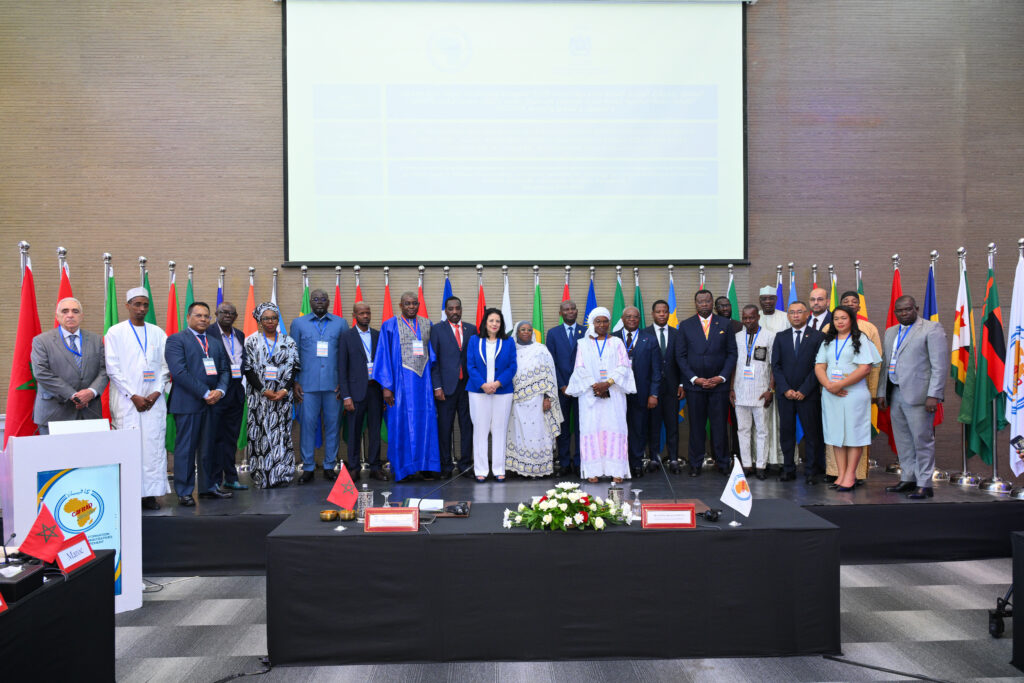
“The best leaders are those whose existence is almost unknown; once their work is done, their objective achieved, it will be said: We did it ourselves.” It was with this maxim from Lao Tzu that Dr. Coffi Dieudonné Assouvi, Director General of CAFRAD, framed the spirit of the 17th Pan-African Ministerial Forum, held on July 14, 2026, at CAFRAD headquarters in Rabat. The forum was intended for Ministers and Governing Board Members, CAFRAD Focal Points in Member States, Ambassadors accredited to Morocco, and other high-ranking African figures and leaders who came to learn about new leadership styles compatible with the VIICAP environment (volatile, uncertain, indeterminate, complex, ambiguous, paradoxical, and dangerous).
Under the theme “Leadership, an essential catalyst for steering public action in a VICAPD context” (volatile, uncertain, complex, ambiguous, paradoxical, dangerous), the Forum opened a high-level debate on a conviction that CAFRAD states unequivocally: “everything in society, within the State or organizations, for better or for worse, depends on leadership” and “no framework, no technology, no instrument will compensate for failing leadership.”
Leadership to be reinvented in the face of a VICAPD world
In his opening address entitled: Leadership in the VICA(PD) environment: styles and methods of steering public action,” the Director General of CAFRAD, Dr. Coffi Dieudonné Assouvi, reaffirmed the Organization’s “full readiness” to support member states “in their efforts toward systemic transformation, the development of human and institutional capacities, and the promotion of inclusive, effective governance geared toward sustainable development.”
Today, world leaders are called upon to lead in a context of immense complexity and uncertainty, marked by emergencies, and agility—the ability to perceive, adapt, anticipate, and react effectively in dynamic environments—has become a fundamental requirement of leadership. This is the central theme of the seminar “Leadership, Catalyst—Leading with Agility,” which brought together knowledge from behavioral science, organizational psychology, and systems thinking.
The VUCA model, or VIICAPD, clarifies the characteristics of the current world, allowing us to question the suitability of traditional management models and assess the opportunity to evolve them so that the state is better adapted to this new environment. Once linear and predictable, our world has become VUCA. This acronym is used to describe the societal, economic, technological, and environmental transformations that the state and all public and private organizations are facing. Therefore, Dr. Coffi Dieudonné Assouvi has endeavored to dissect the concept, method, and paradigm of VIICAPD by addressing the following questions:
How can public leaders adapt to such an environment to create value in the delivery of human-centered public services?
What skills must they develop and what methods must they deploy to implement the transformations necessary for steering public action?
It is urgent to redefine, rethink, and reinvent the public action of tomorrow and to develop the skills and professions of the future.
Leadership: A Collective Capacity to Organize
Leadership is not considered an isolated individual attribute, but rather the act of accepting the responsibility to enable others to achieve their objectives in the face of uncertainty—the organization itself being the leadership that allows people to transform the resources at their disposal into the power they need to bring about the change they desire (Ganz, 2024).
It is this demanding conception of leadership—the ability to organize, mobilize, and empower rather than dominate—that CAFRAD placed at the heart of the discussions at this 17th Ministerial Forum, with the new generation of African public decision-makers as its focus.
Five sessions to equip a new generation of leaders
Organized under the Chatham House Rule, the Forum presented its program in five immersive sessions designed to strengthen the behavioral and strategic skills of participants: governing in a VICAPD world; developing emotional intelligence and self-leadership; establishing psychological safety and collaborative leadership; building team agility and resilience; and finally, cultivating the capacity to anticipate the upheavals of the 21st century.
A stated objective: to elevate leadership practices
The Forum’s overall objective is to examine, adapt, and elevate leadership practices in the face of volatility, uncertainty, and complexity, through the development of the transversal, social, emotional, and cognitive skills necessary for the effective exercise of high-level government functions, in the interest of all citizens.
It is with this perspective that CAFRAD, a pillar of the African development, scientific research, and skills-building framework, intends to continue this discussion on leadership with its member states, serving a new generation of African public leaders.