


International Literacy Day 2026: Literacy as a driver of inclusion, development, and prosperity 8 September 2026 – “Literacy for people, the planet, and prosperity”
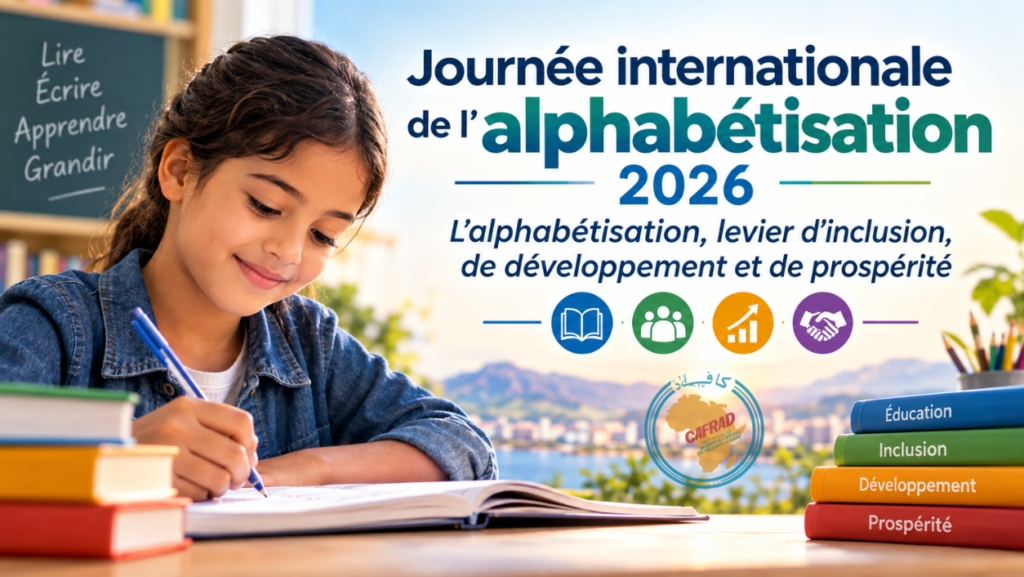
On the occasion of International Literacy Day, celebrated annually on 8 September, the international community reaffirms the fundamental importance of literacy in building more inclusive, equitable, peaceful, and sustainable societies.
The 2026 edition holds special significance as it marks the 60th anniversary of International Literacy Day, proclaimed by UNESCO in 1966. Centered on the theme “Literacy for people, the planet, and prosperity,” this edition offers an opportunity to take stock of the progress made over the past six decades, while paying particular attention to persistent and emerging challenges in a rapidly transforming world.
Literacy: a fundamental right and a driver of transformation
Literacy cannot be reduced merely to the ability to read and write. It serves as an essential foundation enabling individuals to access knowledge, fully exercise their rights, participate in economic and social life, and take part in the decision-making processes that shape their future.
In this sense, literacy contributes directly to social inclusion, equal opportunities, and the strengthening of citizenship. It also fosters individual autonomy and the capacity to adapt to economic, technological, and environmental changes.
Despite the progress achieved, significant needs remain. According to UNESCO data, at least 739 million young people and adults worldwide still lack basic literacy skills, while four out of ten children fail to reach the minimum proficiency level in reading.
These figures serve as a reminder that literacy remains a major priority for public policy and calls for sustained investment in education, training, and skills development.
A strategic issue for Africa
For Africa, literacy is a particularly strategic issue. It contributes to human capital development and is a prerequisite for inclusive and sustainable growth.
In societies facing rapid demographic, economic, digital, and environmental transformations, strengthening the fundamental skills of the population enhances their ability to seize opportunities, access employment, engage in entrepreneurship, and actively participate in the development of their communities.
Literacy also plays a pivotal role in empowering women and young people, reducing inequalities, and improving access to essential services. It thus helps create conditions conducive to broader citizen participation in public life and in economic and social development.
With this in mind, literacy policies must be designed as an integral part of national development strategies and capacity-building policies.
From traditional literacy to mastering 21st-century skills
Technological transformations are redefining the very concept of literacy today. The ability to read and write remains fundamental, but it must now be complemented by new skills that enable citizens to navigate digital environments—which are increasingly pervasive in daily, professional, and administrative life.
Access to technology alone is therefore not enough to guarantee inclusion. It is also necessary to enable people to develop the skills needed to use digital tools autonomously, responsibly, and knowledgeably.
This shift is particularly important in the context of the digital transformation of public administration. The digitization of services, the development of e-government, and the rise of artificial intelligence offer significant opportunities to improve public action, but they also require citizens to possess the skills needed to access these services and derive full benefit from them.
Literacy thus becomes a key element in bridging the digital divide and fostering inclusion in contemporary societies.
Investing in Skills to Build Sustainable Societies
The theme selected for the 2026 edition also highlights the close link between literacy, prosperity, and sustainable development. A better-educated and better-equipped population is more capable of understanding environmental issues, adopting responsible behaviors, and participating in collective efforts to preserve resources and build a sustainable future.
Literacy thus helps strengthen the resilience of individuals and communities in the face of economic, social, and environmental changes.
It also represents a long-term investment in peace and social cohesion. By fostering access to information, mutual understanding, tolerance, and civic participation, it contributes to building fairer and more inclusive societies.
The Role of Institutions and Capacity Building
Promoting literacy requires collective mobilization involving public authorities, training institutions, international organizations, civil society, the private sector, educational establishments, and local communities.
In this context, strengthening institutional and human capacities is a decisive factor. Effective public literacy policies require institutions capable of designing, implementing, monitoring, and evaluating programs tailored to the realities and needs of the population.
It is with this in mind that the African Training and Research Centre in Administration for Development (CAFRAD) reaffirms the importance of skills development and capacity building as essential drivers of effective, inclusive public governance oriented towards sustainable development.
Literacy, understood in its broad sense, is an integral part of this dynamic: it constitutes one of the foundations of human capital development and of the capacity of societies to navigate the transformations of their economic, technological, and institutional environments. Literacy for People, the Planet, and Prosperity
On this International Literacy Day 2026, CAFRAD joins the international community in emphasizing that access to foundational skills is far more than just an educational issue; it is an investment in people, institutions, and the future of societies.
As the world undergoes profound transformations, literacy must remain at the heart of policies for human development, inclusion, and capacity building.
Advancing literacy means empowering individuals to better understand their environment, participate fully in society, and contribute to its development. It also means creating the conditions for an Africa that is more inclusive, more resilient, and better prepared to meet the challenges of tomorrow.
Literacy for people, the planet, and prosperity: a commitment for today, an investment for the future.